
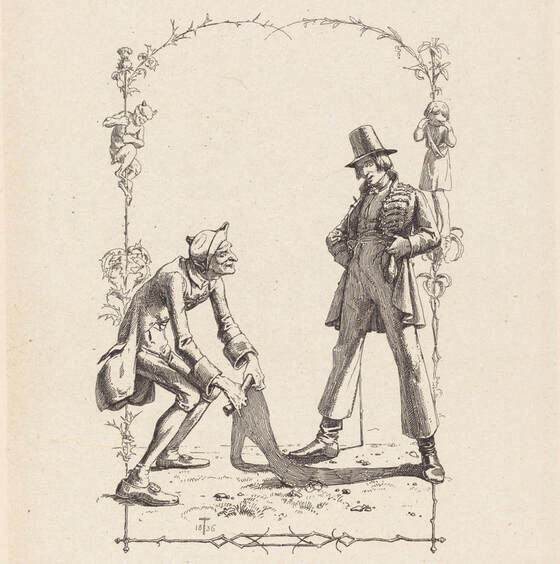
The Story of the Man Who Sold His Shadow to the Devil : A Jungian Perspective
Though apparently written for children, Peter Schlemihl’s Miraculous Story captivated adult readers of the 19th and 20th centuries, was widely translated across Europe, and influenced writers ranging from Kafka and Poe to Calvino, who famously remarked that if he could claim a single work as his own, it would be this fantastic short novel (Calvino, 1994).
The enduring influence of the story of the man who lost his shadow has extended beyond literature and into the realm of psychological thought, echoing unconscious dynamics that defy rational control and resonating particularly with Carl Gustav Jung’s considerations of the shadow a century later.
Peter Schlemihl’s Miraculous Story
Written in German by the exiled French aristocrat Adelbert von Chamisso, Peter Schlemihl’sMiraculous Story was published in 1814, at the dawn of a world eager for progress, searching for light and clarity.
The story follows its eponymous protagonist as he sells his shadow to a mysterious stranger in a grey coat, in exchange for a magic purse that endlessly refills with gold: “After all, it is but a shadow, a mere shadow, which a man can do very well without; and really it is not worth the while to make all this noise about such a trifle. » Feeling the groundlessness of what I was saying, I ceased; and no one condescended to reply.” (Chamisso, 1913, p. 47)
Peter’s unease soon proves justified. Selling something that appears insignificant for all the fortune in the world may look perfect in theory, but its true cost quickly reveals itself in the form of profound alienation.
With the loss of Schlemihl’s shadow, we realize that it is more than an inseparable dark shape seemingly produced by the body; it enables wholeness and mediates connection with others, without which genuine social belonging is impossible.
No matter how wealthy Schlemihl becomes, his shadowlessness makes him uncanny and untrustworthy to others, isolating him from true love and community. Children mock him and adults, alarmed at his absence of a shadow, call him cursed and avoid him. Forced to seek out the company of others only at nightime, when his lack of a shadow is least noticeable, Peter finds himself increasingly alone and lonely.
“As soon as I found myself alone in the rolling vehicle I began to weep bitterly. I had by this time a misgiving that, in the same degree in which gold in this world prevails over merit and virtue, by so much one’s shadow excels gold; and now that I had sacrificed my conscience for riches, and given my shadow in exchange for mere gold, what on earth would become of me ?” (Chamisso, 1913, p. 16)
At some point, desperate, Peter even considers having a false shadow painted for him, but: “‘The false shadow that I might paint,’ said the artist, ‘would be liable to be lost on the slightest movement, particularly in a person who, from your account, cares so little about his shadow. A person without a shadow should keep out of the sun, that is the only safe and rational plan.”” (Chamisso, 1913, p. 25)
One year and a day after the initial bargain, as Peter wanders the world much like his creator once did, the thin grey man reappears with a new temptation, offering to return Peter’s shadow in exchange for his soul…
“And, pray, may I be allowed to inquire what sort of a thing your soul is ? —have you ever seen it ? —and what do you mean to do with it after your death ? You ought to think yourself fortunate in meeting with a customer who during your life, in exchange for this infinitely- minute quantity, this galvanic principle, this polarised agency, or whatever other foolish name you may give it, is willing to bestow on you something substantial—in a word, your own identical shadow.” (Chamisso, 1913, p. 50).
Having certainly guessed by this point the true identity of the mysterious dealer, Peter exclaims, “Who are you?” To which the dealer replies, “What can it signify? Do you not perceive who I am?” (Chamisso, 1913, p. 49).
Peter Schlemihl eventually refuses the new deal, and the story concludes with his own words addressed to the author: “I have selected thee, my dear Chamisso, to be the guardian of my wonderful history, thinking that, when I have left this world, it may afford valuable instruction to the living. As for thee, Chamisso, if thou wouldst live amongst thy fellow-creatures, learn to value thy shadow more than gold; if thou wouldst only live to thyself and thy nobler part—in this thou needest no counsel” (Chamisso, 1913, p. 93).
Making some sense of Peter Schlemihl’s Miraculous Story
Even if we read the story as mere fantasy, or rationalize it as a drama produced by a fevered mind, the question of the shadow’s significance remains. Why is possessing a shadow so vital that losing it sends one’s life into a downward spiral? And what distinguishes shadow from soul, that Peter draws the line at surrendering the latter? And why, then, such a choice of name, Schlemihl, a popular Yiddish term for an unlucky person, pursued by misfortune yet enduring it without complaint?
Following the success of his book, Chamisso was confronted by the persistent curiosity of readers eager to know his true purpose in writing the story of Peter Schlemihl. Questions may have amused as well as annoyed him, for his intention in writing the tale was hardly precise enough to allow a formal account of it afterward. According to his editor, the story came into being spontaneously, “of itself”, “prompted by a self−creating power” (Chamisso, 1913, xi).
Only later did Chamisso reflect on the possible meaning of his own story, ultimately presenting the results of his learned considerations in the editorial prefaces of subsequent editions.
According to Chamisso, the text uses the shadow as a metaphor for what is truly substantial in life. In a quasi-scientific discussion, he explains that, positioned between rays of light and a surface, the shadow marks the space where light is blocked by a solid object, and that its shape depends on both the object and the light source, adding that “a dark body can only be partially illuminated by a bright one.” (Chamisso, 1913, xii)
Chamisso was not only a poet but also a man of science, a botanist, and he conducted in-depth studies of tunicates, those marine invertebrates whose epidermis forms a thin, translucent, or occasionally thick and rigid outer layer.
In Peter Schlemihl, the shadow becomes symbolic, reminding readers that appearances and wealth are fleeting. While money has obvious and recognized value, what is truly substantial, real, enduring, and morally significant commands the highest regard. The shadow reflects inner solidity and stable identity, as well as integrity, evident in ethical character and meaningful relationships, grounded in and expressed through social belonging. Peter’s bitter experience serves as a cautionary call: “Think on the solid, the substantial!” (Chamisso, 1913, xii).
Chamisso’s story was not written to be clear, direct, or concise by contemporary standards of effective communication, and there may be no single meaning to grasp. Perhaps this is precisely its genius. The tale remains alive, vivid, and mysteriously intense, rich with possibilities that provoke thought and invite interpretation, resisting confinement to a fixed understanding.
In hindsight, it is as if the tale anticipated later psychological insights, as Schlemihl’s journey from ignorance to confrontation with his own shadow echoes Jung’s analytical reflections on an ever-present figure, deliberately resistant to full illumination and deeply entwined with the hidden aspects of the self.
Jung’s shadow
Jung explored the shadow for over forty years, experimenting with its power and approaching it through his writings to describe its scope, while never attempting the illusory task of domesticating it. Deliberately avoiding over-defining the shadow, “a concept is a signpost, not a goal” (Jung, 1963, p. 153), he was well aware that the moment one names the shadow, seeking to capture what is inherently inconceivable, it vanishes under the very light of definition.
Close to lived experience, ultimately a symbol more than a concept, “an archetypal figure” (Jacobi, 1942, p. 109), the shadow cannot be simply rationalized or neatly reduced to a definite definition; it must be encountered and confronted as a living part of ourselves. Jung warns against turning living psychic realities into rigid concepts: “It is far more important to experience the psyche than to talk about it.” (Jung, 1963, p. 153)
It is without any certainty that we may trace the origin of the shadow in Jung’s early perception of the psyche as simultaneously unified and plural, forming itself through a polarization process (Agnel, 2008, p. 120). The shadow gradually emerges in Jung’s writings of the 1910s, as he breaks away from Freud and explores the psychology of the unconscious and symbols of transformation. The shadow is present in 1912, through the existence of repressed or unacknowledged aspects of the personality, easily projected onto others, when not indirectly manifesting themselves through various affects, behaviors, or symptoms.
From the 1930s onward, Jung uses the term shadow more explicitly and it becomes recognizable as a distinct psychological concept tied to the personal unconscious. And by 1951, the shadow gets its most systematic and philosophically dense treatment by Jung, as well as its most precise definition: “The shadow is a moral problem that challenges the whole ego-personality, for no one can become conscious of the shadow without considerable moral effort. To become conscious of it involves recognizing the dark aspects of the personality as present and real. This act is the essential condition for any kind of self-knowledge, and it therefore, as a rule, meets with considerable resistance.” (Jung, 1969, CW 9ii, §14)
In later reflections, Jung clarifies that the shadow should not be mistaken for a “dark side” of the psyche in general, nor for the unconscious as such. The shadow represents the unknown aspects of the personality, those parts the ego refuses to recognize as its own (Jung, 1970, CW 10, §455), as well as latent capacities, and “childish or primitive qualities which would in no way be harmful if they were recognized.” (Jung, 1970, CW 10, §456)
As long as those qualities persist in a dark shadow existence, we continue to live “below our level” (Jacobi, 1942, p. 112). If we dare to pay attention, we may encounter sudden shadow manifestations in life events or in dreams at night, speaking symbolically and revealing previously repressed abilities, unfulfilled personal potentials, and developmental tasks we have neglected. When these capacities are noticed and welcomed, they allow richer expressions of the self and may foster personal development (Agnel, 2008, p. 122). Traits we unconsciously possess may be brought to light, often qualities we admire in others but have failed to recognize in ourselves, including talents we are reluctant to acknowledge.
Facing the shadow serves as a crucial step toward genuine self-knowledge. It plays a central role in individuation, the process by which we become whole as psychological individuals, unified, gradually recognizing and embracing our innermost uniqueness. Jung considered individuation the primary task of the second half of life (Schlamm, 2014, p. 866).
Schlemihl meets Jung
Through a captivating fantastic tale and analytical psychological reflections, Chamisso and Jung converge on what may be most crucial: the shadow exists. Both agree that the shadow is empirically observable in its effects, morally significant, and uniquely manifested in each individual. Interestingly, classical physics would likely also validate these characteristics of the shadow, except for the moral dimension, a realm in which science remains silent and unequipped to judge.
For both Chamisso and Jung, the shadow is not a problem to be solved or eradicated, but a formative domain of human experience that calls for lived experience. The shadow plays a counterbalance to idealistic illusions, and acknowledging its existence constitutes the beginning of its integration into a broader personality, bringing us depth and substance (Agnel, 2008, p. 121).
When we reject our shadow to gain acceptance and belonging, we risk over-identifying with the persona, the socially approved mask we wear to shine, exert influence, and signal how we wish to be seen. Beyond the initial surge of motivation and the tangible gains, we may fall into the fantasy that we are truly invincible, “unstoppable” like a “Porsche with no brakes” (Furler, 2016). When others’ perceived expectations shape, guide, and eventually define our adult lives, we may develop a “false self” that hinders genuine relationships and constrains self-expression. As a misguided way out, we may become fixated on wealth, sacrificing almost everything to its artifices and becoming trapped in a vicious circle, ultimately losing ourselves.
Enriched by Jung’s insights, the enigmatic presence of the shadow retains its complexity and preserves its evocative potential, while guiding us to sharpen our sensory capacities, revealing nuanced layers of significance that unfold rather than resolve.
Freeing himself of some obsolete limitations of his persona and choosing integrity over a superficial restoration, Peter refuses to exchange his soul for the return of his shadow and abandons the magical purse altogether. The shadow cannot simply be discarded or commodified; it must be acknowledged and embraced. This may well be an implicit recognition that, eventually, genuine humanity requires the stripping away of false goods, ego-driven identity, complacent grounding, and even unreflective virtue. As painful as it may be, the loss of the shadow can be a purifying process through which we learn that, while substance matters, the soul remains paramount, and that everything else, if clung to uncritically, can turn from a support for life into an obstacle to it.
Individuals who aspire to develop beyond superficial adaptations must eventually face and negotiate with their shadow: “One does not become enlightened by imagining figures of light, but by making the darkness conscious.” (Jung, CW12, §126). Wholeness arises not from denying what lies in the shadow, but from integrating it into a broader and more conscious life narrative.
Perhaps intriguingly, Jung himself never openly discussed Peter Schlemihl in his written works, but his close research fellow and collaborator, the Swiss analyst Marie-Louise von Franz, explicitly refers to the tale. She describes Peter Schlemihl as a man who, by losing his shadow, cuts himself off from instinct, embodiment, and moral reality, appearing uncanny to others and experiencing an inner void (von Franz, 1974, pp. 28-32). Evil, she argues, arises not from having a shadow, but from refusing it (von Franz, 1974, p. 32).
“I have permit me, sir, to say beheld with unspeakable admiration your most beautiful shadow, and remarked the air of noble indifference with which you, at the same time, turn from the glorious picture at your feet, as if disdaining to vouchsafe a glance at it. Excuse the boldness of my proposal, but perhaps you would have no objection to sell me your shadow?” (Chamisso, 1913, p. 19)
Acknowledging the shadow
At some point in our lives, usually around midlife, we may come to understand more clearly that the dark needs the light, and vice versa, and begin to accept that some unrecognized parts of ourselves remain with us, continuing to influence our lives beneath the threshold of our conscious minds.
After devoting our most productive years to crafting effective personas that allow us to navigate the world and learn from life in real situations, we may care less about what others think and feel less pressure to please or conform. As we become ready to witness potentially difficult thoughts and feelings about ourselves, and to welcome them with more compassion than in our youthful years, we may dare to open ourselves more fully to our own curiosity.
“Lo visible es un adorno de lo invisible” (The visible is an ornament of the invisible), wrote the poet Roberto Juarroz (2005, p. 10). What if he was ultimately right, and there is more to life?
Around midlife, it is not that uncommon to feel the need to take stock of who we have become, as though the soul itself were calling for attention. Typically occurring between the ages of forty and forty-five, though sometimes earlier or later, midlife is often characterized by heightened introspection, with varying degrees of reflection, crisis, and opportunity for growth. The period commonly involves a reappraisal of earlier anxieties, guilt, dependencies, animosities, and vanities as we reassess the direction and meaning of our lives (Levinson, 1978).
While in his mid-fifties, Jung himself suggested: “We cannot live the afternoon of life according to the programme of life’s morning, for what was great in the morning will be little at evening, and what in the morning was true will at evening have become a lie.” (Jung, CW 8, §784)
Chamisso, for his part, may have been remarkably precocious, as he wrote Peter Schlemihl at the age of thirty-two, shortly after expressing to Madame de Staël a profound sense of estrangement. In their correspondence, he described himself as feeling like a stranger everywhere: “I am a Frenchman in Germany and a German in France; a Catholic among Protestants, a Protestant among Catholics; a philosopher among the religious, a worldly man among the learned, and a pedant to the worldly; a Jacobin among aristocrats, and among democrats a nobleman… Nowhere am I at home!” (Chamisso, 1839, p. 391).
Writing about Peter Schlemihl may have been Chamisso’s way of following Jung’s advice: “…Where the fear, there is your task! You must study your fantasies and dreams in order to find out what you ought to do…” (Jung, 1976, p. 306)
As Jung notices through his practice and research, the contents of the shadow are predominantly emotional, and they can destabilize conscious awareness, especially when they have been long ignored or repressed (Agnel, 2008, p. 120). The shadow may suddenly slips out sideways and manifests in the lives of otherwise responsible and composed professionals, without announcing itself, in ways that feel out of character, as sudden compulsions or impulses. Especially under stress, during crises, or on the edge of burnout, shadow material may flood to the surface, triggering emotional overreactions, reckless behavior or even identity “cracks.”
As we acknowledge more openly the diversity of our inner parts as a path to greater self-awareness, we may eventually dare to ask ourselves, “What’s really going on here?”
If we embrace as a reality the fact that “the shadow is an invisible but inseparable part of our psychic totality” (Jacobi, 1942, p. 109), running parallel to the development of our ego and embodying what is set aside while growing up, repressed while constructing and strengthening our conscious personality (Jacobi, 1942, p. 110), we may, at some point, begin to wonder what has happened to it … What have we left aside in the shadow?
James Hollis, a contemporary American Jungian analyst, interprets Jung’s shadow as “unlived life energy”, which then seek expression, often unconsciously: “What is not faced inwardly will play out in our external world; whatever burdens within will, sooner or later, burden without.” (Hollis, 2005, p. 77), affecting also our relationships: “Interpersonal relationships are always troubled when we are troubled within.” (Hollis, 2005, p. 77).
The task, therefore, is about reclaiming “unlived life,” and any eruption, anger, grief, desire, is meaningful: it signals something essential has been excluded from consciousness and is demanding recognition (Hollis, 1993).
Facing the shadow
According to Jung, there is no safe “seven-step plan” for facing the shadow: “There is no generally effective technique for assimilating the shadow. It is more like diplomacy (…) and it is always an individual matter. First one has to accept and take seriously the existence of the shadow. Second, one has to become aware of its qualities and intentions. This happens through conscientious attention to moods, fantasies and impulses. Third, a long process of negociation is unavoidable.” (Jung, 1970, CW14 §514).
Story-telling or a form of inner reflection akin to daydreaming, a “wakened reverie,” may offer a more valuable way to approach and engage with the shadow than structured methodologies. By allowing the mind to wander spontaneously, remaining unfocused and receptive to unconsciously generated images and associations that might otherwise go unacknowledged, we create space to explore how the socially constructed masks of earlier life phases can meet, integrate, and ultimately even be transcended.
In this playful, “both-and” mental exploration, and as our capacity to work with paradox develops, we move “towards a higher plane of understanding in which paradoxical poles are understood as complex interdependencies rather than competing interests.” (Jarzabkowski et al., 2023, p. 249) Previously disowned or repressed aspects of the self can re-emerge, becoming available for conscious acceptance, while elements of personal potential previously constrained by social expectations or internalized self-definitions may be allowed to find expression (Biggs, 2003, p. 376).
Embracing one’s own life story
“We are the meaning-seeking, meaning-creating animals” (Hollis, 2005, p. 6), and the critical summons of the second half of life may well be to recover a personal sense of authority, engage with unlived potential, and consciously acknowledge, or even partially integrate, one’s shadow. In doing so, we dare to live as faithfully as possible with the inner guiding force within us, the part that seeks meaning, calls for self-exploration, and urges the integration of all aspects of our being, which Jung and Chamisso call the soul.
Each of us eventually chooses the stories that resonate and matter most to us, reinventing our contours and boundaries, or lets the narratives that have defined our destinies until now continue to lead our lives from the shadows.
Engaging the shadow is an intimate experience, a courageous encounter with the unknown, one in which unsuspected shapes are allowed to express themselves and hidden forms emerge, bringing substance to life through contrast.
Ultimately, it’s up to us to approach the shadow, ignore it, or even decide whether it is real or merely a fable. And, should the opportunity arise, to sell it or not.
References
Agnel, A. (Ed.). (2008). Dictionnaire Jung. Paris: Ellipses.
Biggs, S. (2003). Lifelong learning in the mature age: Policies, practices and possibilities. International Journal of Lifelong Education, 22(4), 369–382.
Calvino, I. (1994). The art of fiction No. 130 (Interview by W. Weaver). The Paris Review, 130.
Chamisso, A. von. (1839). Leben und Briefe (Vol. I, Edited by J. E. Hitzig). Leipzig: Weidmann’sche Buchhandlung.
Chamisso, A. von. (1899). Peter Schlemihl: The shadowless man (Translated by J. Jacobs; Illustrated by Sir P. Burne Jones). London: George Allen. [PDF download from Internet Archive]
Chamisso, A. von. (1913). The marvellous history of the shadowless man; and The cold heart (A. S. Rappoport, Intro.; F. Robson, Illus.). London: Holden & Hardingham.
Chamisso, A. von. (1992). Peter Schlemiel: The man who sold his shadow. New York: Fromm International.
Furler, S., Braide. C. (2016). Unstoppable [Song]. On This Is Acting (track 5). Monkey Puzzle Records/RCA Records.
Hollis, J. (1993). The middle passage: From misery to meaning in midlife. New York, NY: HarperCollins.
Hollis, J. (2005). Finding meaning in the second half of life. New York: Random House.
Jacobi, J. (1942). The psychology of C. G. Jung: An introduction with illustrations. London: Routledge & Kegan Paul.
Jarzabkowski, P., Lê, J. K., & Van de Ven, A. H. (2013). Responding to competing strategic demands: How organizing, belonging, and performing paradoxes coevolve. Strategic Organization, 11(3), 245–280.
Juarroz, R. (2005). Poesía vertical (Vol. 2). Buenos Aires: Emecé Editores.
Jung, C. G. (1963). Memories, dreams, reflections (A. Jaffé, Ed.; R. & C. Winston, Trans.). New York, NY: Pantheon Books.
Jung, C. G. (1967). The relations between the ego and the unconscious. In Collected works of C. G. Jung (Vol. 7: Two essays in analytical psychology, pp. 121–241). Princeton, NJ: Princeton University Press.
Jung, C. G. (1968). Psychology and alchemy. In Collected works of C. G. Jung (Vol. 12). Princeton, NJ: Princeton University Press.
Jung, C. G. (1969a). The stages of life. In Collected works of C. G. Jung (Vol. 8). Princeton, NJ: Princeton University Press.
Jung, C. G. (1969b). Aion: Researches into the phenomenology of the self. In Collected works of C. G. Jung (Vol. 9, Pt. 2). Princeton, NJ: Princeton University Press.
Jung, C. G. (1970a). Psychology and religion: West and East. In Collected works of C. G. Jung (Vol. 11). Princeton, NJ: Princeton University Press.
Jung, C. G. (1970b). Mysterium coniunctionis. In Collected works of C. G. Jung (Vol. 14). Princeton, NJ: Princeton University Press.
Jung, C. G. (1970c). Civilization in transition. In Collected works of C. G. Jung (Vol. 10). Princeton, NJ: Princeton University Press.
Jung, C. G. (1976). Letters of C. G. Jung, Volume II: 1951–1961. (G. Adler & A. Jaffé, Ed.). London: Routledge & Kegan Paul.
Levinson, D. J. (1978). The seasons of a man’s life. New York, NY: Knopf.
Schlamm, L. (2014). Individuation. In D. A. Leeming (Ed.), Encyclopedia of psychology and religion. Boston, MA: Springer.
Von Franz, M.-L. (1974). The shadow and evil in fairy tales. Boston: Shambhala.