Genève, October 2026
More often than I used to, perhaps because I am growing older myself, I receive requests from professionals approaching the end of their careers. Tired, sometimes exhausted, they feel increasingly detached from the concerns that have driven them until now. The future feels narrower, the meaning of the present grows blurred, as though the epic hero’s journey were coming to an end. And now what? … One must carry on, keep going, as the demands of “practical reason” seem to dictate. Keep going, “until the end,” even if it means gritting one’s teeth. Even when belief in what one is doing has all but faded, financial reality does not allow one simply to stop carrying on as before, pressing forward.
Sometimes, one question remains, voiced almost as an attempt to gather whatever breath is left: “Do you think you can help me?” But what, exactly, is there to respond to? The exhaustion? The ineffective solutions already tried in an effort to get organised? The fear of what comes after? Or something harder to name, something that emerges when what has given meaning to our existence begins to crumble?
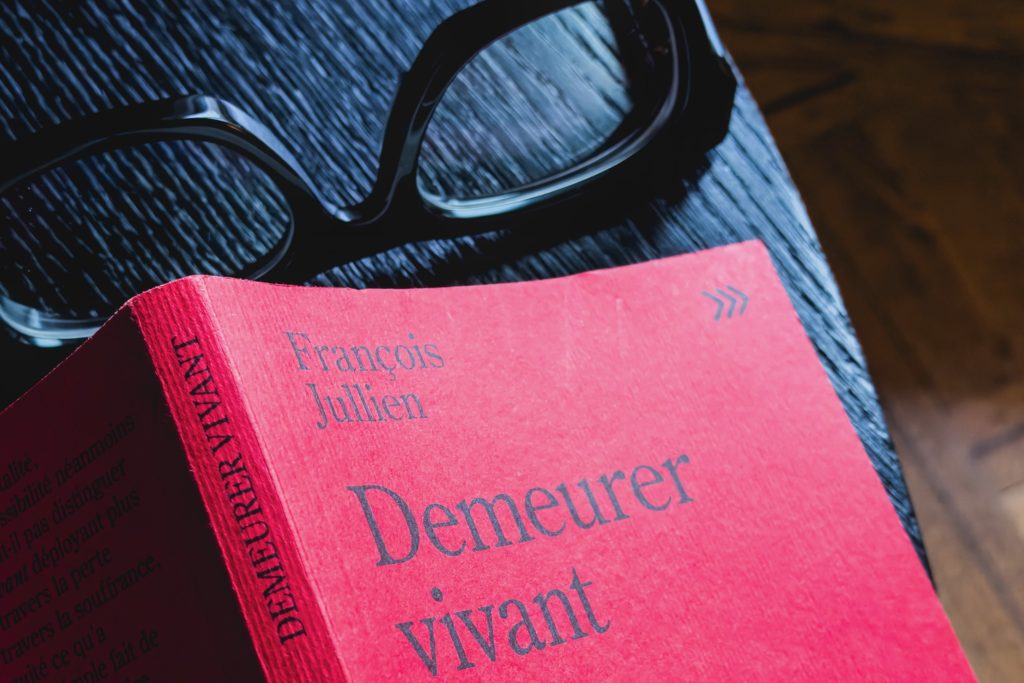
In his 2026 book Demeurer vivant – Au grand Âge (Staying Alive – In Old Age), the French philosopher and sinologist François Jullien explores the possibility of a second life. Not a new life that replaces the first, but another way of inhabiting the life we have lived until now.
With age, or rather thanks to it, we become able to step back from our past life and, in François Jullien’s words, re-possibilise it, reclaiming it in a different way.
Who is François Jullien addressing by publishing this book at the age of 75? The old, who might be the only ones truly able to understand it? All those who will become old, and who are more or less approaching old age? Or those who, while still active, take care of the elderly?
His words resonate with us long before we reach old age. They speak to us already, echoing experiences of our own. This is a concise book, just 113 pages, quick to read and asking little of our time, so tightly accounted for while we remain caught up in working life.
A craftsman of words, François Jullien describes a second life that may be more readily approached through poetic language, often drawn upon by psychoanalysis too, than through the behavioural frameworks of scientific psychology. Poetry gives expression to the complexity of lived experience and helps us find our bearings in the psychological meanderings of our existence, at once universal and singular.
As retirement comes to mind and into view, its hour draws closer. It gradually takes shape as a date marked on the calendar, an interruption to the familiar course of everyday life. Yet it also brings with it the prospect of old age, which, though it has been approaching for a long time, is beginning to make itself felt here and there within us.
It is no longer a matter of progressing, but of preserving, of preserving as much as we can of what cannot be preserved. But might we not go a little further? That ‘a little further’ would be decisive. And could we even go closer to the essential, as the expression ‘nourishing one’s life’ suggests? Nourishing not only the body, but one’s life (Jullien, 2026, pp. 41–42).
How, then, are we to “nourish our life”? And is it still worth the effort when fatigue catches up with us ever more quickly, in a world that seems increasingly restless?
To “nourish one’s life,” as François Jullien proposes, is first of all to clear away what obstructs its movement. As we sweep the ground outside our own door, we must clear away what, within us, slows life down or brings it to a standstill. Our habits, acquired ideas and attachments can eventually confine us to an existence that no longer renews itself. This is not necessarily about pursuing a goal or surpassing ourselves, but about keeping life in motion, finding a way through where it seems to have become stuck.
Nor does “nourishing one’s life” mean trying at all costs to preserve it and prolong it, which would paradoxically hinder its momentum. Clinging to life, refusing death, means obstructing the natural movement of alternation and renewal that sustains it. Life is not something we can possess.
Let life both come and go, like the ebb and flow of the sea outside, like the exhalation and inhalation of breath within. Welcome the influx of life and accompany it on its departure, continually. What is distinctive about life is precisely that it escapes itself (Jullien, 2026, pp. 54–55).
The second life begins when finitude ceases to be an abstract idea and truly enters our intimate horizon. The awareness that our life will come to an end transforms our relationship with the present. The question is no longer simply how to prepare for what comes next, but what is still worth living for. In the light of the life we have lived so far, we can withdraw our investment from what now seems sterile and reinvest it in what genuinely sustains us.
This possibility rests on a lucidity that cannot be taught or decreed. It takes shape through experience, with age, in all that we have lived, lost and endured.
Gradually, certain representations begin to fall away. We stop looking at life solely through the lens of our convictions and habits. We begin to glimpse it differently, not as a truth hidden behind it, but by discerning what reveals itself within it as our ageing certainties gradually fade.
Something has gradually frayed in what I believed, and now I see, not ‘beyond’ life, but through it. I reach the filigree, the fibre that, within the fabric or element of life, allows what life essentially is to emerge (Jullien, 2026, p. 65).
The loosening that follows imposes neither direction nor destination. It opens up a space, a breadth of life we could scarcely have imagined when we were still so absorbed in our ambitions, passions and interests. A new present begins to reveal itself.
My present is what now presents itself to me as a single expanse, stretching between today, when I begin to truly contemplate my death, and the very day of my death: a single unfolding, no longer divided between future and past, and a single extension, from the moment I think about my death to the moment it occurs (Jullien, 2026, p. 56).
This present, this substantial present, was not available to us when we were younger. And yet this active present, as François Jullien also calls it, can begin once we stop postponing or shrinking from the thought of the end of our life, a term that cannot be dated, but is beyond doubt.
It is no longer a matter of desperately seeking to ‘live more,’ nor of dreaming of another life. It is a matter of making better use of this second stretch of time that is beginning, a stretch that begins precisely when its end comes into view (Jullien, 2026, pp. 58–59).
Perhaps also influenced by the Chinese thought that has nourished his life, François Jullien emphasises that this is less a moral or psychological undertaking than a strategic one. Knowing now that our life is receding, we engage with it differently. Daring at last to contemplate our end, allowing ourselves to think about it, is in itself the threshold of another way of living.
The second life therefore does not necessarily begin when we have found a new goal, but when we can loosen our hold on what has prevented us from living differently. Even as our field of action narrows, the possibility of taking initiative remains: to reclaim our life in the light of what it has taught us, and finally to make room for what, within it, has not yet been fully lived.
Reference: François Jullien (2026), Demeurer vivant : Au grand Âge, Paris, Rue de l’échiquier.