
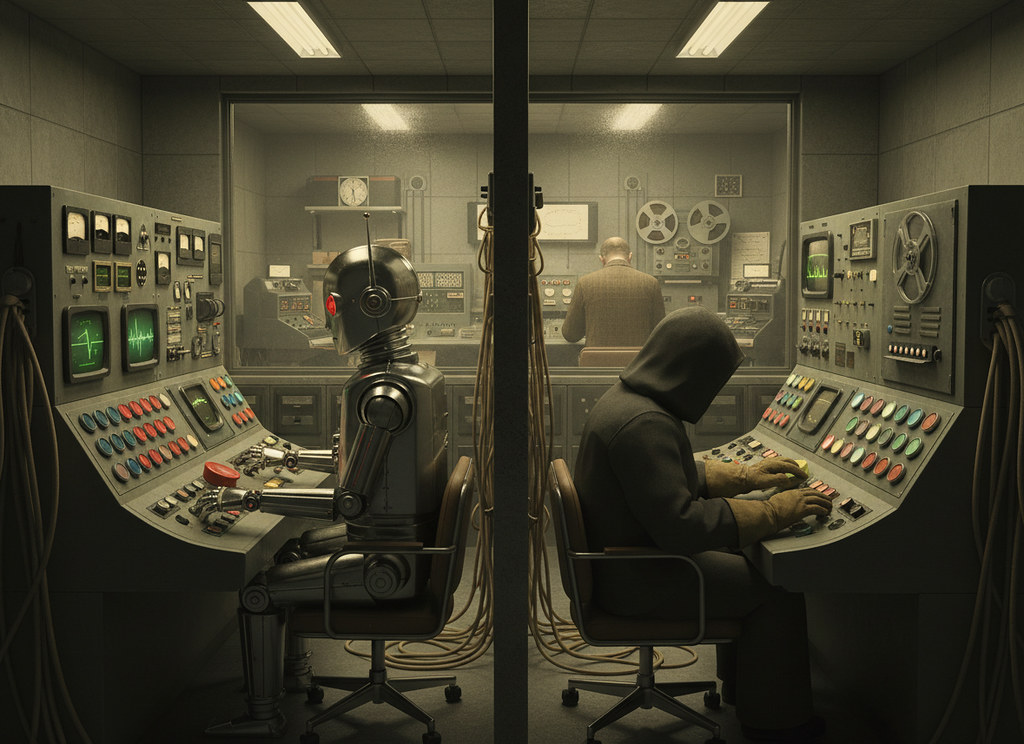
« What distinguishes humans from machines? »
Would you be able to tell whether an answer to this question was written by a human or by artificial intelligence?
In the 1960s, while writing ‘Do Androids Dream of Electric Sheep?’ (later adapted into the famous ‘Blade Runner’), the science-fiction novelist Philip K. Dick asked: If a machine can perfectly simulate human thought, how can we tell it apart from a human?
Alan Turing—a mathematician born in 1912, whose work laid the scientific foundations of computer science—proposed a behavioral answer: if a machine can convince a human that it thinks like one, it should be considered intelligent.
In his fiction, Philip K. Dick introduced another criterion: empathy.
Nevertheless, this distinction may be philosophically real but practically useless; after all, we can’t directly access anyone else’s inner experience.
He pushed the idea further: What if androids (artificial humans) developed empathy too? What about memories, anxiety, doubt, and beliefs embedded in their code? If their suffering is indistinguishable from ours, is it any less real?
In 1968, this was science fiction.
In 2026, when AI pretends to hold conversations, simulate poetry, and express something resembling curiosity or concern, Dick’s question returns with striking vividness: What defines being human? Biology? Consciousness? Empathy? Or simply… the impossibility of answering?
Dick ended with a troubling twist: The best cover for an android would be the one hunting androids.
Or a science fiction writer.
Or today: an AI expert?
NB: This text was inspired by a passage from ‘Je suis vivant et vous êtes morts’, a fictionalized biography of Philip K. Dick by Emmanuel Carrère, published in 1993. It was partially written by Claude, and translated from French into English with ChatGPT.